

What Is the ZED Certification Scheme?
The ZED Certification Scheme is a government initiative aimed at improving the quality, sustainability, and global competitiveness of MSMEs in India. ZED stands for Zero Defect and Zero Effect, focusing on high quality production with minimal environmental impact.
The scheme encourages MSMEs to adopt best manufacturing practices and quality standards.
In 2026, as India accelerates toward becoming a $5 trillion economy, Micro, Small, and Medium Enterprises (MSMEs) remain the backbone of manufacturing and employment, contributing over 30% to GDP and employing millions. However, global competition demands higher quality standards, reduced waste, and sustainable practices. This is where the MSME Sustainable (ZED) Certification Scheme plays a pivotal role.
Launched in 2016 by the Ministry of Micro, Small & Medium Enterprises (MoMSME) and implemented through the Quality Council of India (QCI), ZED stands for Zero Defect Zero Effect. It promotes manufacturing high-quality products (“Zero Defect”) with minimal negative environmental impact (“Zero Effect”). The scheme was revamped in 2022 to include stronger incentives, handholding support, and alignment with India’s net-zero goals by 2070.
The scheme remains valid until March 31, 2026, with extended subsidies and free certification options for women-owned MSMEs. Over 50,000+ MSMEs have benefited so far, achieving reductions in defects by 15-30%, energy savings, and better market access. For Delhi-based MSMEs (in industrial areas like Okhla, Narela, or Wazirpur), ZED certification aligns perfectly with local pollution control norms and export opportunities to Europe and the US, where buyers increasingly demand sustainability certifications.
By adopting ZED principles, MSMEs not only improve internal processes but also gain credibility, government procurement preferences, and access to priority financing. This guide covers everything from eligibility to detailed application steps in 2026.
History and Evolution of the ZED Scheme
The ZED Certification Scheme originated in 2016 as part of the “Make in India” initiative to address quality and environmental gaps in MSMEs. Initially focused on awareness and basic certification, it evolved significantly in 2022 under the MSME Sustainable (ZED) Certification framework.
Key milestones:
- 2016 Launch: Introduced Zero Defect Zero Effect as a national mission.
- 2022 Revamp: Shifted to a three-level structure (Bronze, Silver, Gold) with structured parameters, subsidies, and handholding by QCI-empanelled consultants.
- 2024-2026 Updates: Extended validity till March 31, 2026; free certification for women-owned units; integration with MSME KAWACH incentives; emphasis on digital transactions (95%+ for extra benefits).
The scheme now covers both manufacturing and eligible service MSMEs registered on the Udyam portal. It emphasizes 20 core parameters (expanded from earlier versions), including leadership, process control, energy management, and CSR. Official portal (zed.msme.gov.in) handles registrations, pledges, and assessments transparently no authorized agency charges extra fees for registration.
In Delhi, local clusters (e.g., auto components, textiles) have seen high adoption due to proximity to government offices and export hubs.
Objective of the ZED Certification Scheme
The scheme aims to:
- Promote quality driven manufacturing
- Reduce defects in products and processes
- Minimize environmental impact
- Improve market credibility of MSMEs
- Enable access to domestic and international markets
ZED focuses on long term process improvement rather than short term incentives.
Who Can Apply for ZED Certification?
Eligible applicants include:
- Micro, small, and medium enterprises
- Manufacturing and service sector MSMEs
- Units registered under Udyam
Both existing and operational MSMEs can apply for certification.
Expanded ZED Certification Levels
The ZED Certification is awarded in three progressive levels after taking the ZED Pledge:
- Bronze Level (Entry-Level – 5 Parameters): Focuses on basic quality awareness, leadership commitment, and simple environmental practices. Ideal for startups and micro units. Requires self-assessment and desktop review. Certification cost: ~₹10,000 (before subsidy).
- Silver Level (Intermediate – 14 Parameters): Builds on Bronze with controlled processes, KPIs, risk management, and better resource efficiency. Involves on-site assessment. Suited for growing MSMEs aiming for domestic market expansion. Cost: ~₹40,000.
- Gold Level (Advanced – 20 Parameters): Highest tier, demanding excellence in lean manufacturing, innovation, CSR, energy optimization, and full sustainability. Positions MSMEs for exports and global standards. Includes comprehensive audits. Cost: ~₹90,000.
Here’s a comparison table:
| Level | Parameters | Focus Areas | Typical Subsidy (Micro/Small/Medium) | Ideal For |
|---|---|---|---|---|
| Bronze | 5 | Basics: Leadership, quality basics | 80%/60%/50% + extra for women/SC/ST | Startups, micro units |
| Silver | 14 | Process control, KPIs, environment | Same as above | Scaling MSMEs |
| Gold | 20 | Lean, innovation, full sustainability | Same + priority incentives | Export-ready, advanced units |
New Section: Key Parameters Assessed in ZED Certification
ZED evaluates MSMEs on 20 structured parameters (divided into sub-parameters). Key ones include:
- Leadership & Strategy
- Product/Process Design
- Manufacturing/Operations
- Quality Management
- Environment & Energy Management
- Occupational Health & Safety
- Human Resource Development
- Measurement & Analysis
- Risk Management
- Lean Practices … (up to 20: CSR, Innovation, etc.)
For example:
- Environment parameter checks emissions, waste recycling, and cleaner production.
- Energy management promotes efficient usage and renewable adoption.
- Lean manufacturing reduces waste through tools like 5S and Kaizen.
MSMEs start with self-assessment on the ZED portal, then progress to verification. Official guidelines (available on zed.msme.gov.in) provide detailed checklists.
Benefits + Case Studies of ZED Certification for MSMEs
MSMEs certified under ZED receive several advantages.
Key benefits include:
- Cost Savings: 15-25% reduction in rejections and waste.
- Market Access: Preference in government procurement; easier exports.
- Incentives: Subsidies up to 80% (micro), free for women-owned; Bank of Maharashtra priority loans.
- Sustainability Edge: Aligns with global ESG demands.
- Improved product quality and consistency
- Reduced rejection and rework costs
- Better resource efficiency
- Enhanced brand credibility
- Preference in government procurement
- Improved access to markets and buyers
The scheme supports long term competitiveness rather than direct financial assistance.
Real Success Stories:
- A Pune automotive MSME achieved Silver level in 2025, reporting 40% productivity increase via automation and waste reduction.
- Gilard Electronics (Himachal) earned high-level certification, boosting exports significantly through buyer confidence.
- Many Delhi textile units reduced energy costs by 20% after adopting ZED practices.
These examples show tangible ROI within 1-2 years.
Financial Support Under the ZED Scheme
The government provides financial assistance for:
- Certification costs
- Assessment and evaluation fees
Subsidy percentage varies based on:
- MSME category
- Location
- Ownership type
Women owned and SC ST owned enterprises receive higher support.
Documents Required for ZED Certification
Common documents include:
- Udyam registration certificate
- Aadhaar and PAN
- Business registration documents
- Manufacturing or service details
- Process and quality documentation
Additional information may be required during assessment.
Steps to Apply for the ZED Certification Scheme
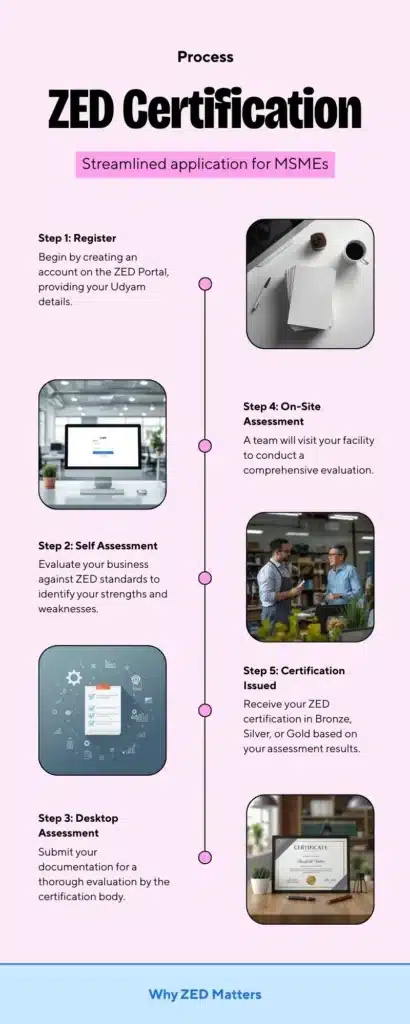
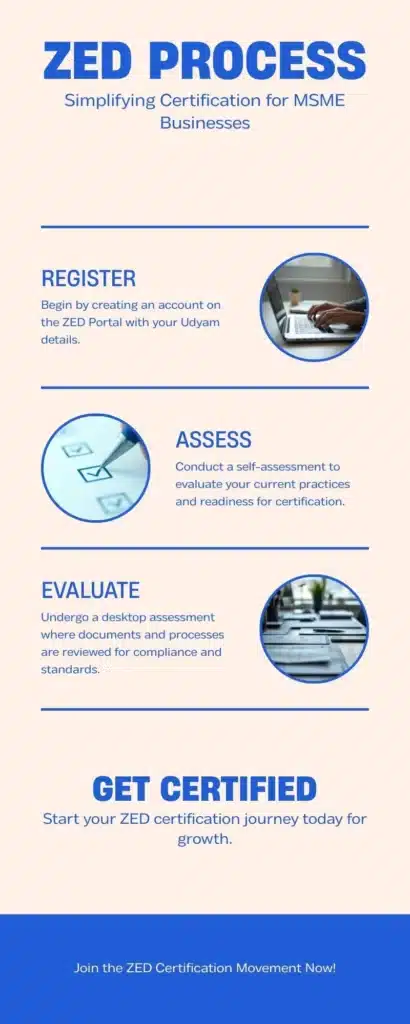
Step 1: Register on ZED Portal
MSMEs must register on the official ZED certification platform using Udyam details.
Step 2: Self Assessment
Enter business and process information to complete the self assessment.
Step 3: Desktop Assessment
Documents are reviewed by the implementing agency.
Step 4: On Site Assessment
Physical verification may be conducted based on the chosen certification level.
Step 5: Certification Issuance
After successful evaluation, ZED certification is issued at the applicable level.
Validity of ZED Certification
ZED certification is valid for a specified period and may require renewal based on updated assessment criteria.
Regular process improvements help maintain higher certification levels.
Common Reasons for ZED Certification Rejection
Applications may face issues due to:
- Incomplete documentation
- Poor process compliance
- Inaccurate self assessment
- Non adherence to quality benchmarks
Preparation and internal audits improve approval chances.
Common Challenges & Solutions in ZED Certification
Challenges in ZED Certification
- Documentation gaps or inaccurate self-assessment.
- Initial costs (mitigated by subsidies).
- Time for on-site audits (1-3 months).
Solutions
- Conduct internal audits first.
- Use free QCI training videos on YouTube.
- Engage empanelled consultants for handholding (subsidized).
ZED Certification Scheme FAQs
What is ZED certification?
Who can apply for ZED certification?
What are the objectives of ZED certification?
Improve product quality
Reduce defects in manufacturing
Minimise environmental impact
Promote sustainable and responsible production
What are the levels of ZED certification?
What are the benefits of ZED certification for MSMEs?
Improve brand credibility
Access government incentives and subsidies
Enhance market and export opportunities
Reduce production waste and costs
How is ZED certification useful for exports?
Is there government support for ZED certification?
Is ZED certification mandatory for MSMEs?
Is ZED applicable to service sector MSMEs?
Does ZED certification provide direct subsidies?
GSCE Insight
ZED certification delivers the most value to MSMEs that genuinely focus on process improvement. Treating it as a badge alone limits impact; integrating ZED principles into daily operations creates long term gains.
Follow GSCE to learn more about MSME Schemes.

Dalip Singh is an SEO analyst, content strategist, and MSME-focused researcher with hands-on experience in search engine optimization, government schemes, and digital visibility for small businesses. Through GSCE, he builds a knowledge-first platform that simplifies MSME schemes, subsidies, compliance, and policy updates in clear, practical language. He also writes movie and web series reviews, combining analytical insight with storytelling to make both policy and entertainment content easy to understand for readers across India.

