

PMEGP Scheme 2026 Introduction
In the dynamic landscape of India’s economy, where Micro, Small, and Medium Enterprises (MSMEs) contribute over 30% to GDP and employ millions, government schemes like the Prime Minister’s Employment Generation Programme (PMEGP) play a crucial role in fostering entrepreneurship.
Launched to bridge the gap between innovative ideas and financial resources, PMEGP Scheme is a credit-linked subsidy scheme designed to promote self-employment and small business ventures in both rural and urban areas. As we enter 2026, the scheme continues to be a lifeline for aspiring entrepreneurs, especially in urban hubs like Delhi, where industrial clusters in areas such as Okhla and Narela thrive.
PMEGP Scheme targets first-time entrepreneurs, traditional artisans, and unemployed youth by providing financial assistance through bank loans subsidized by the government. This reduces the initial capital burden and encourages sustainable business models that generate local employment. With an emphasis on non-farm sectors, the scheme aligns with India’s broader goals of economic self-reliance under initiatives like “Aatmanirbhar Bharat” and the 2026-27 Union Budget’s focus on MSME growth.
In this comprehensive guide, we’ll explore the PMEGP scheme’s history, objectives, eligibility, covered businesses, loan and subsidy details, application process, common pitfalls, benefits, real success stories, challenges, Delhi-specific information, and frequently asked questions. Whether you’re a Delhi-based artisan or a young professional eyeing a startup, PMEGP could be your gateway to economic independence.
History and Evolution of the PMEGP Scheme
The PMEGP scheme has its roots in earlier employment generation programs. It was officially launched on August 15, 2008, by the Government of India, merging two existing schemes: the Prime Minister’s Rojgar Yojana (PMRY, started in 1993 for urban youth) and the Rural Employment Generation Programme (REGP, launched in 1995 by the Khadi and Village Industries Commission or KVIC). This consolidation aimed to streamline efforts and create a unified credit-linked subsidy mechanism for micro-enterprises across rural and urban India.
Administered by the Ministry of Micro, Small and Medium Enterprises (MoMSME), PMEGP Scheme is implemented nationally by KVIC as the nodal agency. At the state level, it involves State KVIC Directorates, Khadi and Village Industries Boards (KVIBs), and District Industries Centres (DICs). In Delhi, where no DIC exists, the scheme is handled entirely by the State KVIC and KVIB offices.
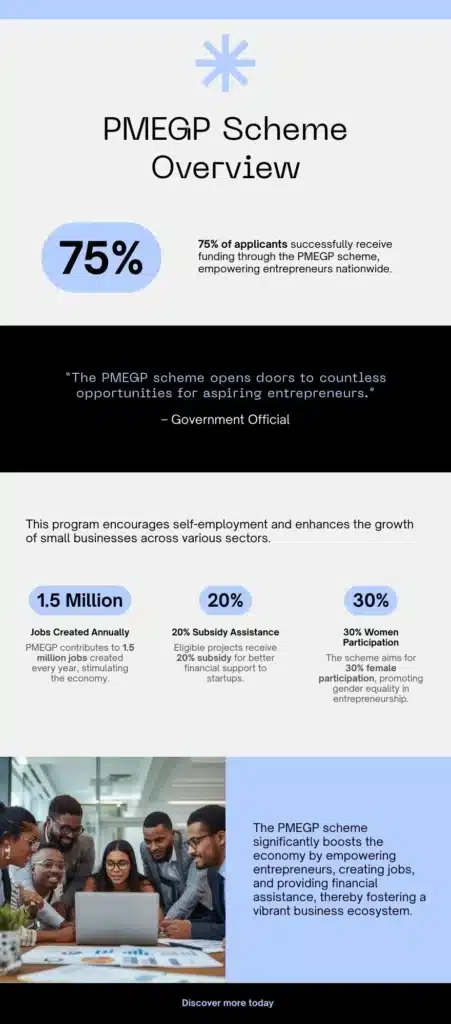
Over the years, PMEGP Scheme has evolved significantly. The scheme was revamped in 2022 with enhanced subsidies, online processes, and inclusion of upgradation for existing units. By 2026, it has assisted over 10.71 lakh micro-enterprises since inception (FY 2008-09 to December 2025), disbursing Rs 29,249.43 crore in margin money subsidies and generating employment for approximately 87 lakh people.
The 2026-27 Union Budget reinforces this with a Rs 10,000 crore SME Growth Fund, potentially integrating with PMEGP Scheme for equity support to high-performing units. An outlay of Rs 13,554.42 crore has been approved for PMEGP from 2021-22 to 2025-26, aiming to set up 4 lakh projects and create 30 lakh jobs. For 2025-26 alone, targets include assisting around 85,500 new units and generating 6.84 lakh jobs.
This evolution reflects India’s shift towards digitalization, with fully online applications since 2022, reducing paperwork and speeding up approvals. In Delhi, the scheme has seen increased uptake in sectors like food processing and IT services, contributing to the city’s vibrant MSME ecosystem.
Objectives of the PMEGP Scheme
The primary goal of PMEGP is to generate sustainable employment opportunities in rural and urban areas by supporting the establishment of new micro-enterprises in the non-farm sector. Key objectives include:
- Employment Generation: To create jobs at the local level, targeting traditional artisans, unemployed youth, and rural populations to curb urban migration.
- Entrepreneurship Promotion: Encourage self-employment among diverse groups, including women, SC/ST, minorities, ex-servicemen, and physically handicapped individuals.
- Economic Stability: Boost wage-earning capacity of artisans and contribute to rural and urban economic growth.
- Inclusive Development: Prioritize special categories with higher subsidies, aligning with India’s inclusive growth agenda.
In 2026, these objectives are amplified by integration with other schemes like Credit Guarantee Fund Trust for Micro and Small Enterprises (CGTMSE) for collateral-free loans. For Delhi entrepreneurs, this means easier access to funding for urban ventures like digital services or wellness centers.
Who Can Apply for the PMEGP Scheme? Eligibility Criteria
PMEGP is inclusive, with no income ceiling for assistance. Eligible applicants must be above 18 years old and focus on new enterprises (existing units qualify for upgradation under specific conditions). Udyam registration is mandatory.
Detailed eligibility table:
| Criteria | Requirement |
|---|---|
| Age | Above 18 years |
| Business Status | New enterprises; existing PMEGP/REGP/MUDRA units for upgradation |
| Registration | Udyam registration mandatory |
| Prior Benefits | No prior PMEGP subsidy availed |
| Location | Rural and urban areas (rural defined under KVIC Act 2006) |
| Special Categories | SC/ST/OBC/Minorities/Women/Ex-servicemen/Physically handicapped/NER/Hill/Border areas/Aspirational districts/Transgender for higher subsidies |
Institutions like self-help groups, cooperative societies, and trusts involved in social welfare are also eligible, provided projects are viable and not in negative lists (e.g., tobacco, plastic carry bags). In Delhi, applicants from special categories (e.g., women entrepreneurs) benefit from 25% urban subsidy.
Businesses Covered Under PMEGP
PMEGP supports manufacturing and service-based activities in the non-farm sector. Pure trading is excluded, but activities like agro-processing are encouraged.
Expanded table with examples:
| Business Category | Examples |
|---|---|
| Manufacturing | Food processing units (e.g., spices, dairy), textile and garment units, leather goods, handicrafts, small machinery workshops, organic fertilizer production |
| Service-Based | Repair and maintenance services (e.g., auto garages, electronics), beauty and wellness services (e.g., salons, gyms), IT and digital services (e.g., software development, graphic design), logistics and transport support (e.g., courier services) |
| Traditional/Artisan | Khadi activities, handloom weaving, pottery, bamboo crafts, agro-based processing (e.g., honey extraction) |
In 2025-26, 63% of assisted units were in manufacturing and 93% in services with projects up to Rs 10 lakh. For Delhi, urban-focused services like IT consulting or wellness centers are popular due to high demand.
PMEGP Loan and Subsidy Details
PMEGP provides bank loans with government subsidies (margin money) adjusted post-implementation. Maximum project cost: Rs 50 lakh for manufacturing, Rs 20 lakh for services (up from Rs 25 lakh/10 lakh in earlier guidelines).
Subsidy rates:
| Category | Beneficiary Contribution | Subsidy (Urban) | Subsidy (Rural) |
|---|---|---|---|
| General | 10% | 15% | 25% |
| Special (SC/ST/Women etc.) | 5% | 25% | 35% |
Subsidy is locked as a Term Deposit Receipt (TDR) for 3 years, interest-free. No collateral for loans up to Rs 10 lakh, covered by CGTMSE. In Delhi (urban), general category gets 15% subsidy, special 25%.
Applicant Contribution Requirement
Applicants must contribute 5-10% of the project cost, keeping barriers low. This ensures commitment while making the scheme accessible. For a Rs 20 lakh project, a general category applicant contributes Rs 2 lakh, with subsidy covering up to Rs 3 lakh (urban).
Documents Required for PMEGP Application
Prepare these for smooth processing:
| Document Type | Purpose |
|---|---|
| Aadhaar Card | Identity verification |
| PAN Card | Financial identification |
| Udyam Registration Certificate | MSME verification |
| Project Report | Business viability assessment (include cost estimates, projections, employment details) |
| Bank Account Details | Loan and subsidy disbursement |
| Address Proof | Location verification |
| Educational/Technical Certificates (if applicable) | For skilled trades |
| Category Certificate (for special categories) | To claim higher subsidy |
Banks may request additional docs like caste certificates or EDP training proof.
How to Apply for the PMEGP Scheme: Step-by-Step Process
The process is fully online via the KVIC portal (kviconline.gov.in/pmegpeportal), with SMS/email updates. Approval timelines vary (1-3 months), depending on bank appraisal.
- Check Eligibility: Confirm age, new enterprise status, Udyam registration.
- Prepare Project Report: Detail business plan, costs (fixed/working capital), projections (3-5 years), employment (aim for 8-10 jobs per unit). Use free templates from KVIC.
- Register on PMEGP Portal: Visit kviconline.gov.in/pmegpeportal, enter Aadhaar, create login.
- Fill Application Form: Enter personal/business details, upload docs, select bank/implementing agency (KVIC/KVIB/DIC).
- Bank Appraisal and Verification: Bank evaluates viability, conducts field visit, checks credit history.
- Loan Sanction and Margin Money Release: Upon approval, loan sanctioned; subsidy released as TDR.
- Business Setup and Monitoring: Set up unit, ensure fund utilization; KVIC monitors for 3 years.
Important: Select activity carefully, avoid inflated costs. EDP training (2-10 days) is mandatory post-sanction.
Common Reasons for PMEGP Application Rejection
Rejections often stem from:
- Incomplete/inaccurate project reports (e.g., unrealistic projections).
- Ineligible activities (e.g., trading).
- Missing documents or poor credit history.
- Lack of repayment capacity or prior defaults.
To avoid: Consult KVIC offices, use realistic estimates.
PMEGP Scheme Benefits for MSMEs
Benefits include:
- Reduced capital burden with subsidies.
- Employment creation (average 8 jobs/unit).
- Access to MSME ecosystem (e.g., CGTMSE, interest subvention).
- Formalization via Udyam, eligibility for other schemes.
In 2026, benefits extend to priority loans and export support under Budget initiatives.
Click to know about ‘How to Apply for the Udyam Registration Certificate‘.
Real Success Stories from PMEGP Beneficiaries
PMEGP has transformed lives. Here are verified examples:
- Abhay Kumar (Hazaribagh, Jharkhand): A woodworker struggling with low income, Abhay secured a PMEGP loan to expand his unit. Today, he employs 15 people with Rs 82 lakh annual turnover.
- Manish Kumar (Delhi Region): From repairing cooler motors, Manish started M.K. Industries with PMEGP funding. Now, Rs 25 lakh turnover, employing 15.
- Arunadevi S (Thoothukudi, Tamil Nadu): Took Rs 2.5 lakh subsidy for her unit; now Rs 30 lakh sales, employs 5.
- Budhdeb Das (Nadia, West Bengal): Unemployed youth started exercise book manufacturing with Rs 19.95 lakh loan; employs 22, Rs 118.80 lakh turnover.
- Pradeep Kaur (Punjab): Turned dreams into reality with PMEGP, establishing a successful unit.
These stories highlight PMEGP’s impact, with over 87 lakh jobs created nationwide.
Challenges and Tips for Successful Implementation
Challenges include delays in approvals (due to bank verification), high competition for funds, and EDP training requirements. In 2024-25, loan sanctions declined 45%, signaling need for better awareness.
Tips:
- Prepare detailed, realistic project reports.
- Attend free EDP sessions via RSETI/RUDSETI.
- Monitor funds utilization to avoid subsidy clawback.
- For Delhi: Visit KVIC Delhi office (Gramodaya, 3 Irla Road, Vile Parle West, Mumbai – but local branch at Chandni Chowk or online).
Delhi-Specific Information for PMEGP Applicants
In Delhi, PMEGP is implemented by the Delhi Khadi and Village Industries Board (DKVIB) and KVIC State Office, without DIC involvement. Key contacts:
- KVIC Delhi Zonal Office: 3, Irla Road, Vile Parle (W), Mumbai – but Delhi branch: KVIC, Old Court Building, Kashmere Gate, Delhi-110006. Phone: 011-23868640.
- DKVIB Office: Nigam Bhawan, Kashmere Gate, Delhi-110006. Website: dkvib.delhi.gov.in.
- Application Centers: Submit online, but visit for handholding. Delhi has seen high uptake in urban services, with subsidies at 15-25%.
Local KVIC offices in areas like Chandni Chowk provide training and verification support.
PMEGP Scheme FAQs
Is PMEGP available for existing businesses?
Can PMEGP be combined with other schemes?
How long does approval take?
What is the loan limit?
Is EDP training mandatory?
What if application is rejected?
Delhi-specific: Where to get help?
GSCE Insight
As a former SEO analyst with 5 years of experience, I recommend leveraging digital tools for your PMEGP venture. Many applications fail due to poor project reports, focus on realistic models. For Delhi entrepreneurs, combine PMEGP with local networks like FISME for success. Follow GSCE for more MSME guides.
In conclusion, PMEGP 2026 remains a powerful tool for economic empowerment, especially in Delhi’s urban setting. With consistent effort, it can turn ideas into thriving businesses, contributing to India’s growth story.

Dalip Singh is an SEO analyst, content strategist, and MSME-focused researcher with hands-on experience in search engine optimization, government schemes, and digital visibility for small businesses. Through GSCE, he builds a knowledge-first platform that simplifies MSME schemes, subsidies, compliance, and policy updates in clear, practical language. He also writes movie and web series reviews, combining analytical insight with storytelling to make both policy and entertainment content easy to understand for readers across India.


Pingback: MSME Schemes Government Schemes for MSMEs in India