
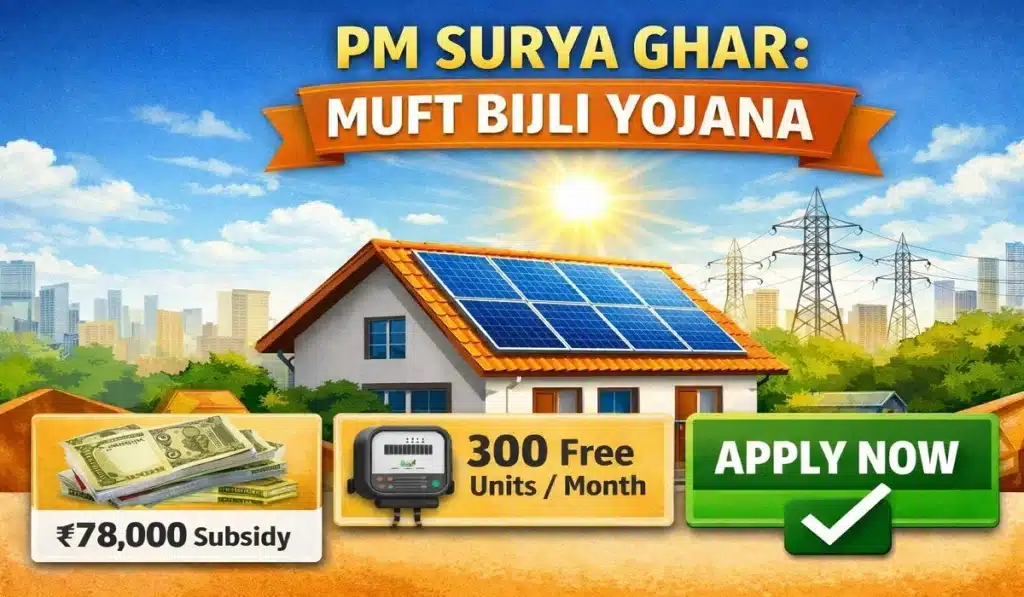
The PM Surya Ghar: Muft Bijli Yojana is a flagship rooftop solar scheme launched by the Government of India to promote clean energy adoption at the household level. The scheme aims to provide up to 300 units of free electricity per month by supporting the installation of rooftop solar systems across 1 crore homes.
This initiative is expected to reduce electricity bills, promote renewable energy, and create employment opportunities in the solar ecosystem, benefiting both households and MSMEs engaged in solar manufacturing, installation, and maintenance.
About PM Surya Ghar: Muft Bijli Yojana
The PM Surya Ghar: Muft Bijli Yojana was launched to accelerate rooftop solar adoption under India’s renewable energy mission. The scheme focuses on residential consumers and provides Central Financial Assistance (CFA) for installing grid-connected rooftop solar systems.
The scheme is implemented through the official portals:
- Solar rooftop portal
- Consumer login portal
- MyScheme portal
The objective is to ensure affordable electricity while supporting India’s climate and energy independence goals.
Objectives of the Scheme
The scheme has been introduced with the following goals:
- Provide up to 300 units of free electricity per month to eligible households
- Reduce dependency on conventional energy sources
- Promote clean and renewable solar energy
- Create employment in solar installation and allied sectors
- Encourage domestic manufacturing of solar components
Key Benefits of PM Surya Ghar Scheme
1. Subsidy Support
The government provides financial assistance for rooftop solar installations:
- Up to ₹30,000 per kW for systems up to 2 kW
- Additional subsidy for capacity up to 3 kW
- Maximum subsidy up to ₹78,000 for residential consumers
The subsidy is transferred directly to the beneficiary’s bank account after installation and inspection.
2. Reduction in Electricity Bills
Beneficiaries can generate their own electricity, reducing dependency on DISCOM supply. Households consuming up to 300 units per month can significantly reduce or eliminate their electricity bills.
3. Net Metering Facility
Under net metering, excess electricity generated can be exported to the grid, allowing consumers to receive bill adjustments or credits.
4. Long-Term Savings
Solar panels typically have a lifespan of 20–25 years, offering long-term financial benefits after recovering the initial investment.
5. Environmental Impact
The scheme contributes to reducing carbon emissions and supports India’s renewable energy targets.
Eligibility Criteria
To apply under the scheme, the applicant must:
- Be an Indian citizen
- Own a residential property with suitable rooftop space
- Have a valid electricity connection
- Not have already availed subsidy for rooftop solar under other central schemes
Documents Required
Applicants typically need:
- Aadhaar card
- Latest electricity bill
- Roof ownership proof
- Bank account details
- Passport-size photograph
How to Apply for PM Surya Ghar: Muft Bijli Yojana
The application process is completely online:
- Visit the official rooftop solar portal.
- Register with mobile number and electricity consumer details.
- Apply for rooftop solar installation.
- Select an empanelled vendor.
- Installation and inspection by DISCOM.
- Subsidy disbursal after approval.
Applicants can track the status through the consumer login portal.
Drawbacks and Challenges of the Scheme
While the scheme offers multiple benefits, there are certain limitations and practical challenges:
1. High Initial Investment
Although subsidy support is available, the remaining cost must be borne by the consumer. For some households, upfront investment can still be substantial.
2. Rooftop Suitability Issues
Not all homes have adequate roof space, correct orientation, or structural strength to install solar panels.
3. State-Level Implementation Delays
Approval timelines, inspection processes, and net-metering approvals may vary by state and DISCOM, sometimes causing delays.
4. Dependence on Grid Connectivity
The scheme is primarily for grid-connected systems. Areas with weak grid infrastructure may face operational challenges.
5. Maintenance Responsibility
Although solar panels require minimal maintenance, cleaning and system upkeep remain the responsibility of the homeowner.
6. Limited Benefit for Low Consumption Households
Households consuming very low electricity may not fully utilize the benefits of a 2–3 kW system, affecting financial returns.
Opportunities for MSMEs
The scheme opens significant business opportunities for MSMEs in:
- Solar panel manufacturing
- Solar inverter and component supply
- Installation and EPC services
- Solar maintenance and cleaning services
- Solar financing and consultancy
With 1 crore households targeted, demand for solar ecosystem services is expected to grow substantially.
Conclusion
The PM Surya Ghar: Muft Bijli Yojana is a transformative initiative aimed at making solar energy accessible to Indian households. By providing financial assistance and promoting rooftop solar installations, the scheme reduces electricity bills and supports environmental sustainability.
However, practical challenges such as upfront investment, rooftop suitability, and state-level implementation delays must be considered before applying. For MSMEs, the scheme presents long-term growth potential in the renewable energy sector.
Frequently Asked Questions (FAQs) – PM Surya Ghar: Muft Bijli Yojana
1. What is PM Surya Ghar: Muft Bijli Yojana?
PM Surya Ghar: Muft Bijli Yojana is a central government scheme that promotes rooftop solar installations for residential households. It aims to provide up to 300 units of free electricity per month by offering financial assistance for installing grid-connected rooftop solar systems.
2. Who is eligible to apply for the scheme?
Indian residential property owners with a valid electricity connection and suitable rooftop space can apply. The applicant should not have already availed subsidy under any other central rooftop solar scheme.
3. How much subsidy is provided under the scheme?
The government provides Central Financial Assistance (CFA):
- Up to ₹30,000 per kW for systems up to 2 kW
- Additional subsidy for capacity up to 3 kW
- Maximum subsidy up to ₹78,000 for residential consumers
The exact subsidy depends on the installed capacity.
4. How many units of free electricity can a household get?
Eligible households can benefit from up to 300 units of electricity per month generated through their rooftop solar system, significantly reducing electricity bills.
5. How can I apply for PM Surya Ghar: Muft Bijli Yojana?
Applicants must register online through the official rooftop solar portal, select their state and DISCOM, choose an empanelled vendor, and complete installation after approval. The subsidy is transferred to the bank account after inspection and commissioning.
6. What documents are required to apply?
Generally required documents include:
- Aadhaar card
- Latest electricity bill
- Roof ownership proof
- Bank account details
- Passport-size photograph
7. What is net metering and how does it work?
Net metering allows consumers to export excess electricity generated by their rooftop solar system to the grid. The exported energy is adjusted against their electricity consumption, reducing the final electricity bill.
8. Is there any upfront cost involved?
Yes. Although subsidy support is provided, the remaining installation cost must be paid by the applicant. The subsidy is credited after installation and verification.
9. Can tenants apply for the scheme?
No. The scheme is primarily for property owners with legal rights over the rooftop where the solar system will be installed.
10. What is the lifespan of a rooftop solar system?
Most rooftop solar panels have a lifespan of 20–25 years. Inverters may require replacement after 8–12 years depending on usage and quality.
11. Can I sell excess electricity generated?
Yes. Through net metering, excess electricity can be exported to the grid, and consumers may receive bill credits or adjustments as per state DISCOM regulations.
12. Are there any limitations or drawbacks?
Some limitations include high upfront investment, rooftop space constraints, state-level approval delays, and maintenance responsibility remaining with the homeowner.
13. Is the scheme available across all states in India?
The scheme is implemented nationwide; however, the process and timelines may vary depending on the state DISCOM and local regulations.
14. How long does the approval and installation process take?
The timeline depends on the state and DISCOM approval process. It typically includes registration, feasibility approval, installation, inspection, and subsidy disbursement.

Dalip Singh is an SEO analyst, content strategist, and MSME-focused researcher with hands-on experience in search engine optimization, government schemes, and digital visibility for small businesses. Through GSCE, he builds a knowledge-first platform that simplifies MSME schemes, subsidies, compliance, and policy updates in clear, practical language. He also writes movie and web series reviews, combining analytical insight with storytelling to make both policy and entertainment content easy to understand for readers across India.

